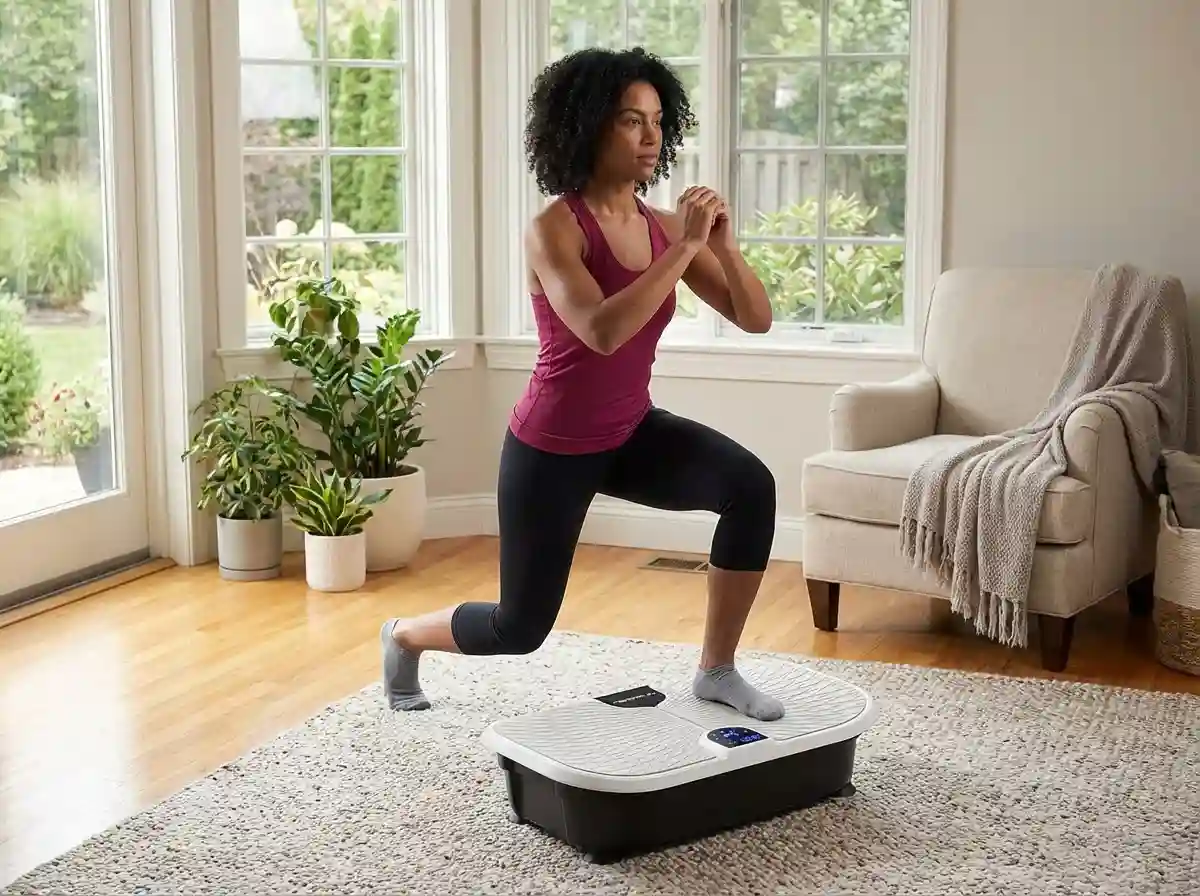
There's a piece of equipment in a lot of gyms that looks, honestly, a little goofy. A flat platform — maybe the size of a bathroom scale on steroids — that hums and shakes while you stand on it. People squat on it. Some just stand there, looking slightly puzzled.
For years it was dismissed as a fitness fad. And fair enough — the wellness industry has given us plenty of those.
But here's the thing: the clinical research on whole-body vibration (WBV) and bone health has quietly been building into something genuinely impressive. We're talking randomized controlled trials, meta-analyses, and HR-pQCT imaging showing changes at the microarchitectural level. This isn't vibrating belt machines from the 1950s. The underlying biology is real, and for certain populations — postmenopausal women, elderly adults at fall risk, children with motor disabilities — the evidence is hard to ignore.
Why Bone Responds to Vibration at All
To understand why standing on a humming platform might strengthen your skeleton, you need a quick primer on how bone works.
Bone is not inert. It's constantly being broken down and rebuilt in a process called remodeling — osteoclasts resorb old bone, osteoblasts lay down new matrix. What governs this balance? Largely, mechanical load. Wolff's Law tells us that bone adapts to the forces placed on it. Load it regularly, and it gets denser. Remove the load — think bed rest or spaceflight — and it wastes away.
When vibration passes through your body, it creates tiny strains in bone tissue and generates fluid flow through the lacunocanalicular network — a microscopic system of channels where osteocytes live. Osteocytes are the most abundant cells in bone, and they are exquisitely sensitive to mechanical cues. Fluid shear stress activates them, and they in turn orchestrate the whole remodeling cascade.
At the molecular level, two pathways do heavy lifting: Piezo1/2 mechanosensitive ion channels in the osteocyte membrane trigger downstream bone-forming signals when physically deformed, while the Wnt/β-catenin pathway promotes osteoblast differentiation and suppresses bone-destroying osteoclasts.
The Parameters Matter Enormously
Not all vibration is the same. The therapeutic effect — or the harm — depends on four key variables: frequency (Hz), amplitude (mm), acceleration (g), and cumulative dose over time.
The 30–45 Hz range consistently shows up in bone-focused research as a sweet spot. This frequency appears to maximize mechanotransduction through the skeletal system without generating jarring forces that cause fatigue damage.
Low-magnitude, high-frequency vibration — around 0.3g at 30–90 Hz — has been used extensively in elderly and frail populations precisely because it delivers a meaningful signal without exceeding the structural tolerance of compromised bone.
What the Clinical Trials Show
Postmenopausal Women
This is the most studied population. A comprehensive meta-analysis of 13 RCTs involving 783 participants found statistically significant improvements in bone mineral density (BMD) at the lumbar spine — a weighted mean difference of 0.018 g/cm² (P = 0.011). At the femoral neck, the improvement was smaller but still significant: 0.005 g/cm² (P = 0.0493).
Studies using high-magnitude protocols for six-month periods have reported lumbar spine gains exceeding 2% — clinically meaningful numbers. One important nuance: studies using HR-pQCT (higher-resolution imaging than standard DXA) have found improvements in trabecular microarchitecture even when areal BMD didn't change dramatically. Bone may be getting structurally stronger in ways standard clinical scans miss.
Children with Motor Disabilities
Kids with cerebral palsy, Down syndrome, or osteogenesis imperfecta often can't engage in normal weight-bearing activities that drive healthy bone acquisition during childhood. A meta-analysis focused on disabled children found that WBV significantly improved femur BMD (SMD = 0.41), total body bone mineral content (SMD = 0.26), and lean body mass. The muscle mass improvements create a positive feedback loop: better muscles → more loading during daily movement → ongoing skeletal stimulus beyond the vibration sessions themselves.
Elderly Adults: The Fall Prevention Angle
Here the clinical argument gets particularly strong — because a fracture requires two things: fragile bone AND a fall. WBV appears to address both.
A systematic review found that WBV reduced fall rates with a reported rate ratio of 0.67 (P = 0.0006). An 18-month cluster-randomized trial of 710 elderly subjects using 35 Hz at 0.3g observed falls in 18.6% of the vibration group vs. 28.7% in controls. The mechanism is neuromuscular: vibration training improves proprioception, postural control, and lower-limb muscle power — all critical for catching yourself when you stumble.
The Bottom Line
Whole-body vibration is not magic. It's not going to replace pharmacotherapy in severe osteoporosis, and it's not for everyone. But dismissing it as a gym gimmick ignores a substantial body of rigorous clinical research.
For postmenopausal women looking to preserve bone without medications (or as an adjunct to them), for elderly adults at fall risk, and for children with motor disabilities who can't acquire bone mass through normal movement — WBV has genuine, evidence-backed value. The key is getting the parameters right: 30–45 Hz, appropriate magnitude for the population, consistent multi-week dosing, and screening carefully for contraindications.
This article is for informational purposes only and does not constitute medical advice. Always consult a qualified healthcare professional before beginning any new therapy, particularly for conditions involving bone health or fall risk.
Ready to Train Smarter?
Explore FEIERDUN® equipment — engineered for real results at every fitness level.